Lawmakers Chart the Future at Tennessee Valley Corridor Summit
Tennessee Today
CHATTANOOGA, TN — If there was a single theme that dominated conversations at last week’s Tennessee Valley Corridor National Summit in Chattanooga, it was this: the Tennessee Valley is no longer preparing for the future, but is actively building it.
For two days, elected officials, business leaders, researchers, energy experts, and innovators gathered in downtown Chattanooga to discuss the technologies poised to shape the next century. From artificial intelligence and quantum computing to advanced nuclear energy, the message was clear: Tennessee intends to be at the center of it all.
As host of the summit, Congressman Chuck Fleischmann framed the conversation around the region’s greatest competitive advantage- energy.
Fleischmann’s main takeaway for the audience was how the Tennessee Valley Authority is ‘uniquely positioned’ to maintain affordable electricity, pointing to the TVA’s diverse energy portfolio and growing role in meeting America’s rising power demands.
With data centers, advanced manufacturing, and emerging technologies requiring unprecedented amounts of electricity, energy policy was the heart beat of this 2-day event. Congressman Fleischmann emphasized that TVA’s success depends on maintaining a balanced mix of energy sources rather than relying on a single solution.
“It’s about supply and demand and choosing the right energy resources,” he said. “You would not want to pick one source of energy, because, God forbid, if it became too expensive, you’re going to have to pass that on to your ratepayers.”
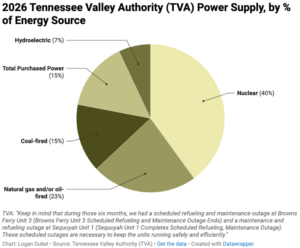
Chart: Logan Dubel Source: Tennessee Valley Authority (TVA)
As chairman of the House Appropriations Subcommittee on Energy and Water Development, Fleischmann highlighted Tennessee’s growing influence in the nuclear sector, describing East Tennessee as the epicenter of the industry’s expansion. He also pointed to major federal investments in nuclear power and supercomputing as critical to maintaining America’s competitive edge.
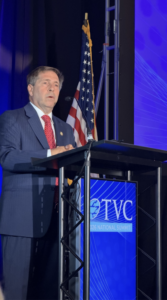
Credit: Congressman Chuck Fleischmann Official Facebook
“What we want to do is make sure that America continues to be dominant in energy,” Fleischmann said. That spirit of competition and Tennessee pride was an anchor for many of the event’s other discussions.
Throughout the summit, Chattanooga’s emergence as a national leader in quantum technology took center stage. Speakers repeatedly pointed to the city’s partnership between EPB and the University of Tennessee at Chattanooga, which has helped establish the nation’s first commercially available quantum network and positioned the city as a hub for next-generation computing.
“Chattanooga has always been on the cutting, leading edge of things,” Fleischmann said. “The reality is, we are leading again. Just like we were the gig city, we are now going to be the quantum city.”
The summit’s keynote address from Senator Marsha Blackburn broadened the conversation from regional development to national security.
“Tennessee must lead in emerging technologies like AI, quantum, and nuclear to ensure America’s national security and global dominance,” Blackburn told attendees.
Blackburn argued that artificial intelligence, quantum computing, and advanced nuclear energy are increasingly interconnected and that America’s ability to lead in each depends on success in the others.
“Quantum will provide the rails that AI will ride on – while handling complex computations needed for advanced reactors,” Blackburn said. “AI is accelerating the development of quantum computers while aiding the construction and operation of reactors. And nuclear energy will provide the reliable, base-load power needed to scale up AI and quantum infrastructure.”
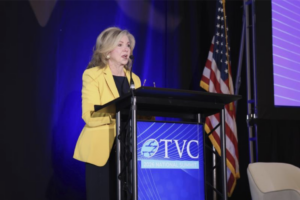
Credit: Chattanoogan
The senator repeatedly returned to the idea that Tennessee is uniquely positioned to capitalize on these developments. From Oak Ridge National Laboratory and Y-12 to Vanderbilt University, UTC, EPB, Fort Campbell, Arnold Air Force Base, and the University of Memphis, Blackburn outlined an innovation ecosystem stretching from one end of the state to the other.
“With all the assets Tennessee has, we are better positioned than any other state to lead in these emerging technologies and address our nation’s most pressing national security issues,” she said.
Her remarks also highlighted ongoing efforts in Washington to establish a federal framework for artificial intelligence, expand quantum research through the National Quantum Initiative Act, and accelerate the development of advanced nuclear energy.
Throughout the conference, there was a growing recognition that the Tennessee Valley’s future economic success may be tied directly to its ability to produce power, attract talent, and commercialize emerging technologies faster than competing regions around the world.
The stakes, participants argued, extend far beyond economic development.
“We know the CCP (Chinese Communist Party) is pouring billions of dollars into this research,” Blackburn said. “We cannot let them win. It is going to be important that we take advantage of what we have and strategically develop these technologies.”
For Chattanooga, the summit served as both a showcase and a statement. Once known nationally for reinventing itself through broadband infrastructure, the city is now making a bid to become a leader in quantum technology, advanced computing, and energy innovation.
And if the conversations at the Tennessee Valley Corridor Summit are any indication, the region’s leaders believe the next chapter of American technological leadership may very well be written in Tennessee.
###